← Overview
Getting started

A recorded walkthrough

The bundled demo replays a full Claude session — a plan, three chapters of edits, a subagent, and a workflow — and the observatory records all of it. This page shows that demo as recorded in VS Code and PyCharm; the same walkthrough is clickable in the browser.

If Claude Observatory is installed, run claude-observatory demo to follow along; installation is one line in the README.

01
The session

Run the demo

claude-observatory demo replays a scripted session through the real pipeline — a real transcript, with edits captured by the real hooks — inside an isolated demo-* session and an observatory-demo/ folder. Claude plans three to-dos and the Overview turns them into chapters: each edit lands under the goal it served, the module strip and file ledger update live, and the fleet row on the left tracks the agent's phase and ±lines. Everything shown is derived from the transcript and the capture hooks, at zero extra tokens.
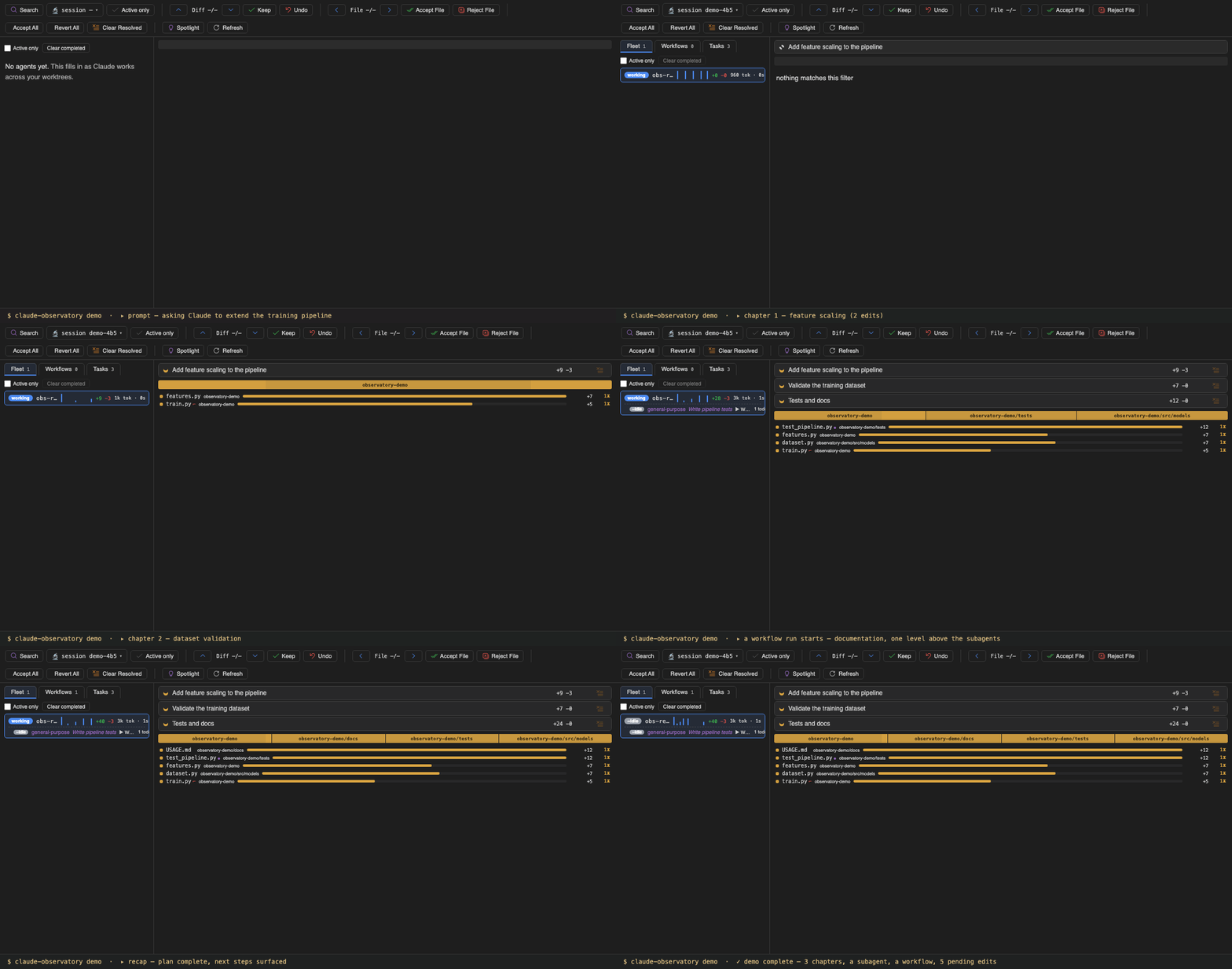
Recording of the live demo in VS Code: the actual Overview webview filling in as the session runs — the chapter ribbon completing chapter by chapter, the module strip and churn-ranked file ledger growing with each edit, and the fleet agent's phase and ±lines updating live
Recorded from a demo run — the Overview panel as the session progresses.
02
Multi-agent work

Subagents and workflows

Mid-session, Claude delegates the tests to a subagent. It appears nested under its parent in the Fleet nav with its own phase, current task, and ±lines, and its edit is attributed to it by its action window rather than guessed. A workflow run then starts an agent one level above the subagents: the nav focuses the new run, shows it running, and on completion lists its phase groups, per-agent tokens · time · edits, and the run's own change-map slice — its chapters and files — on the right.
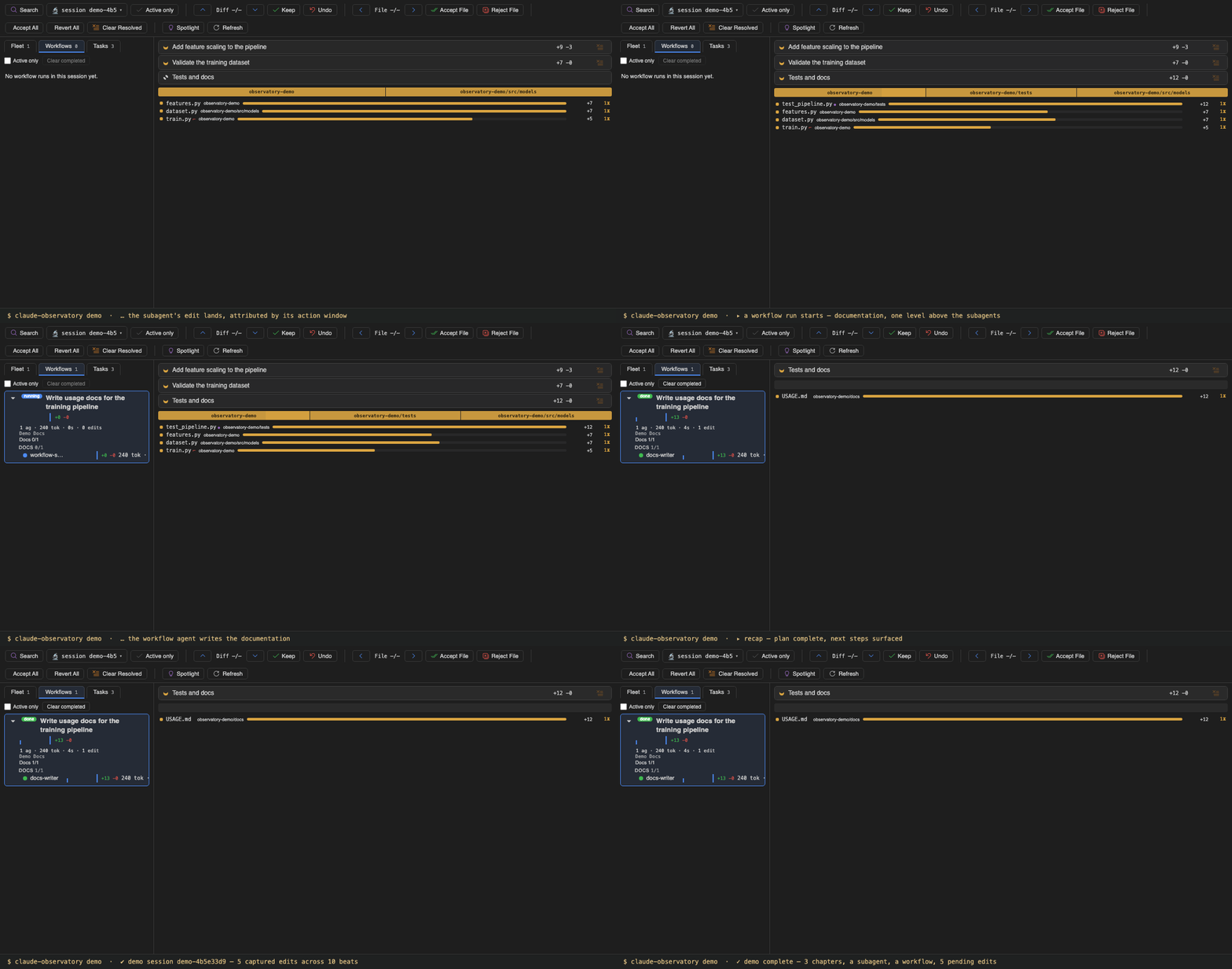
Recording of the workflow arc in the Workflows nav: the empty tab, the run appearing while still running, its agent's documentation edit landing, then the completed run with its Docs phase group, per-agent tokens, time, and edits — with the run's own change-map slice on the right
Recorded from the Workflows tab — a run moves from running to complete, with its own change-map slice.
03
PyCharm

The same session in JetBrains IDEs

The JetBrains plugin renders the same multitask and changemap payloads in native tool windows: the Fleet and Workflows nav, the chapter rows with their per-chapter ✓ ↩ 🧹, the module strip, and the ledger. Every rollup is computed once in core and rendered as given, so both editors show identical numbers.
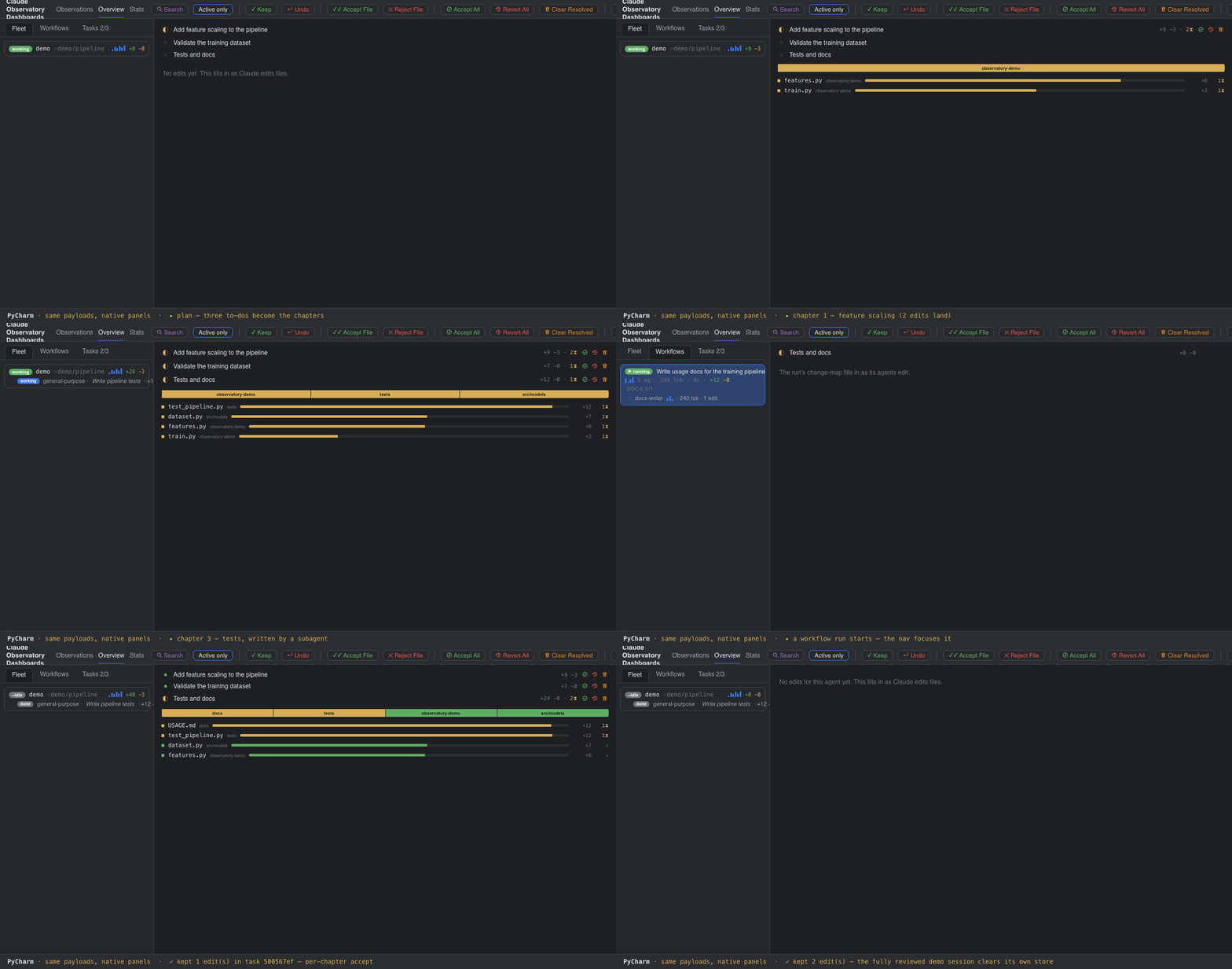
The same demo session in PyCharm's Claude Observatory Dashboards tool window: the Fleet nav with the working agent and its subagent, chapters filling in with per-chapter review buttons, the workflow run with its Docs phase, and the review ending in a cleared store
The Overview in PyCharm — the same payloads rendered in native Swing panels.
04
The review

Review by chapter

The demo's edits are real store records on real files, so the review works normally. Each chapter's ✓ accepts exactly the edits its row shows: accepting the first two chapters settles their rows while the third stays pending. Reject works the same way, conflict-guarded per edit, and clicking a chapter scopes the toolbar's bulk actions to it. A fully reviewed demo clears its own store, and claude-observatory demo --clean removes the session, the store, and the demo folder entirely.
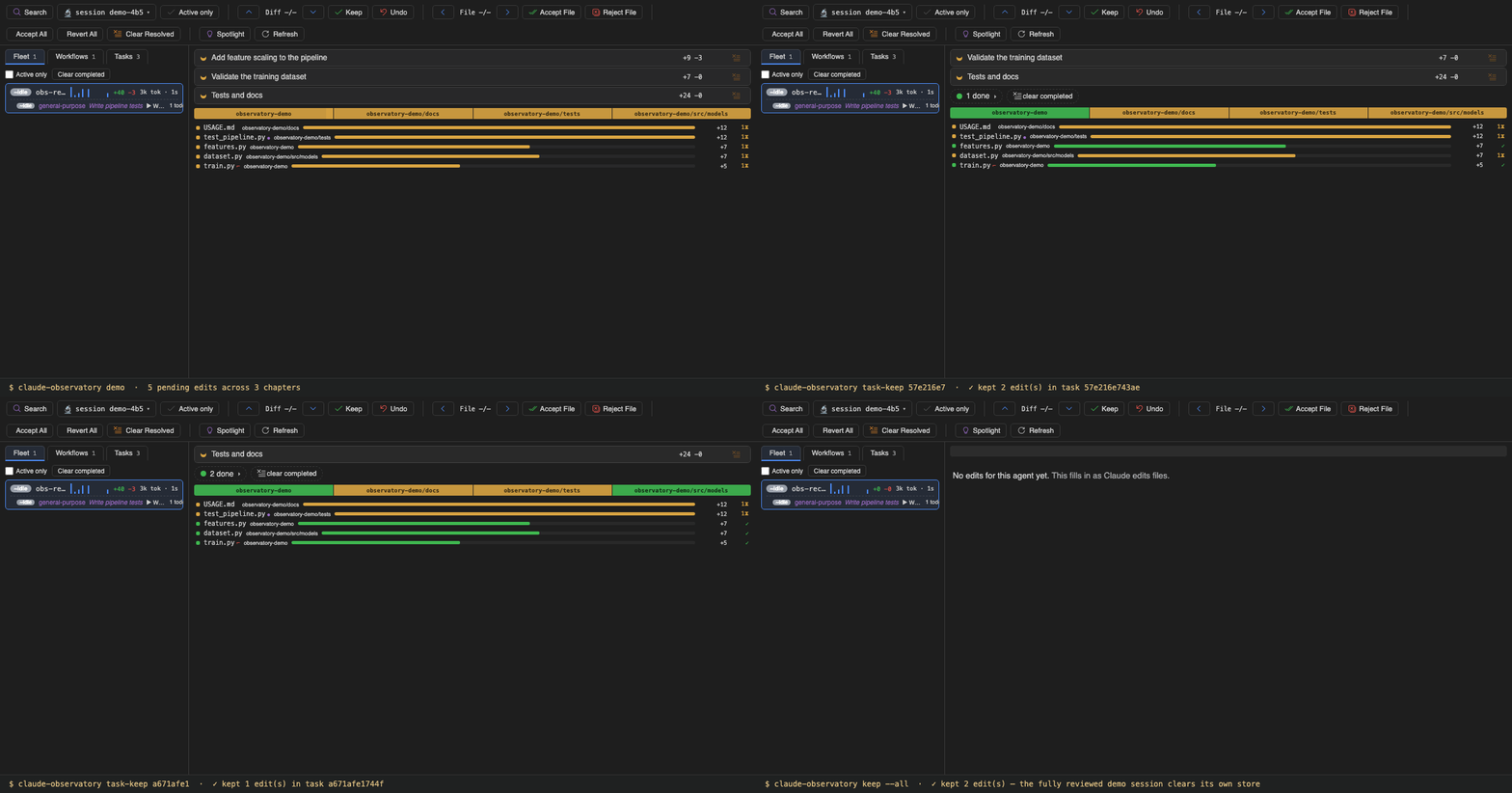
Recording of the review: task-keep accepting the first chapter — its row settles to green while the others stay pending — then the second, then Accept All clearing the fully-reviewed demo store to an empty panel
Chapter operations against the demo store — WYSIWYG accept per chapter, then Accept All clears the reviewed store.
05
Beyond the demo

Working with real sessions

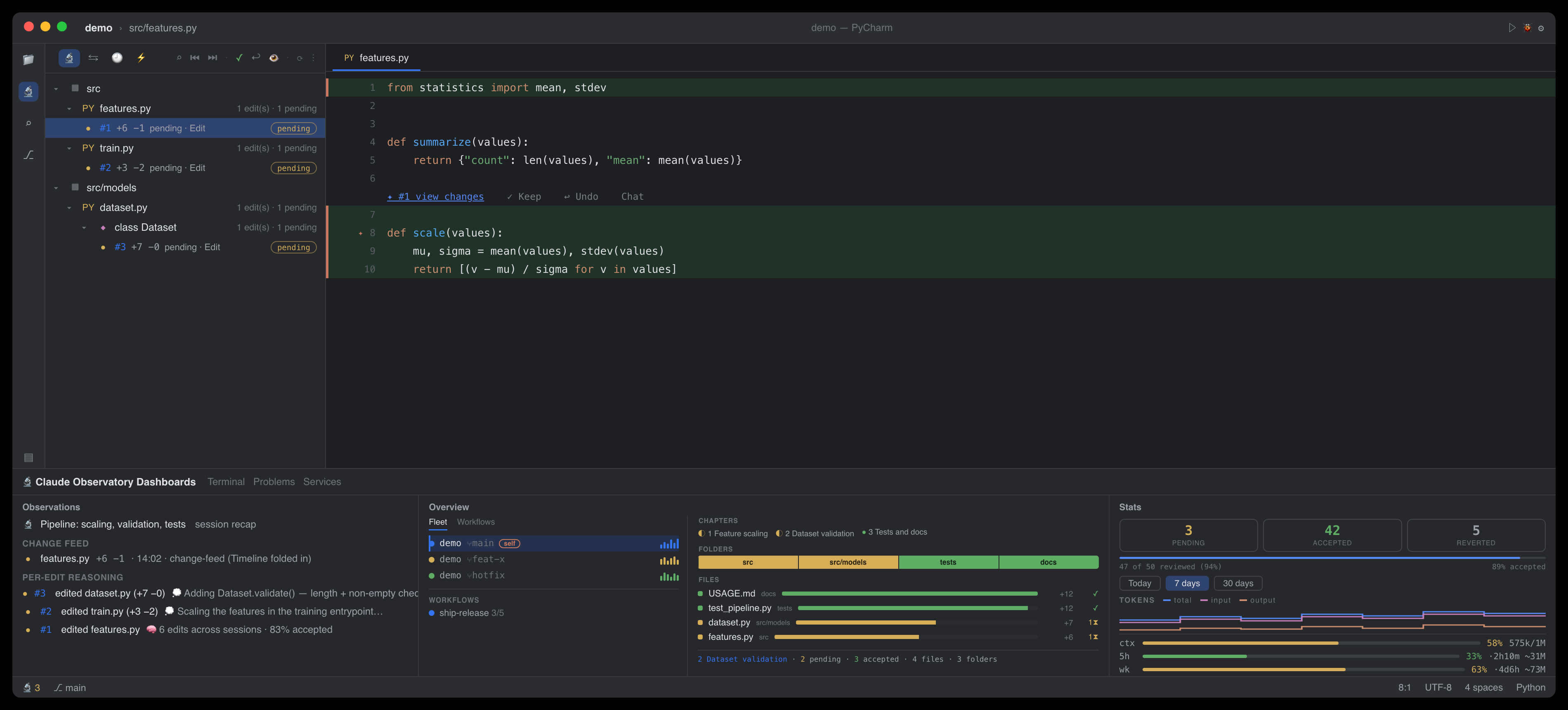
Run claude-observatory init once, with Claude Code closed, and every later session is captured automatically — the same chapters, fleet, workflows, and review as the demo, in the 🔬 Claude Edits sidebar and the Claude Observatory panel in both editors. Sessions running in several git worktrees are unified into one fleet in the Overview, live conflicts included (in the Actions view); the Active only toggle narrows the list to work still in progress.
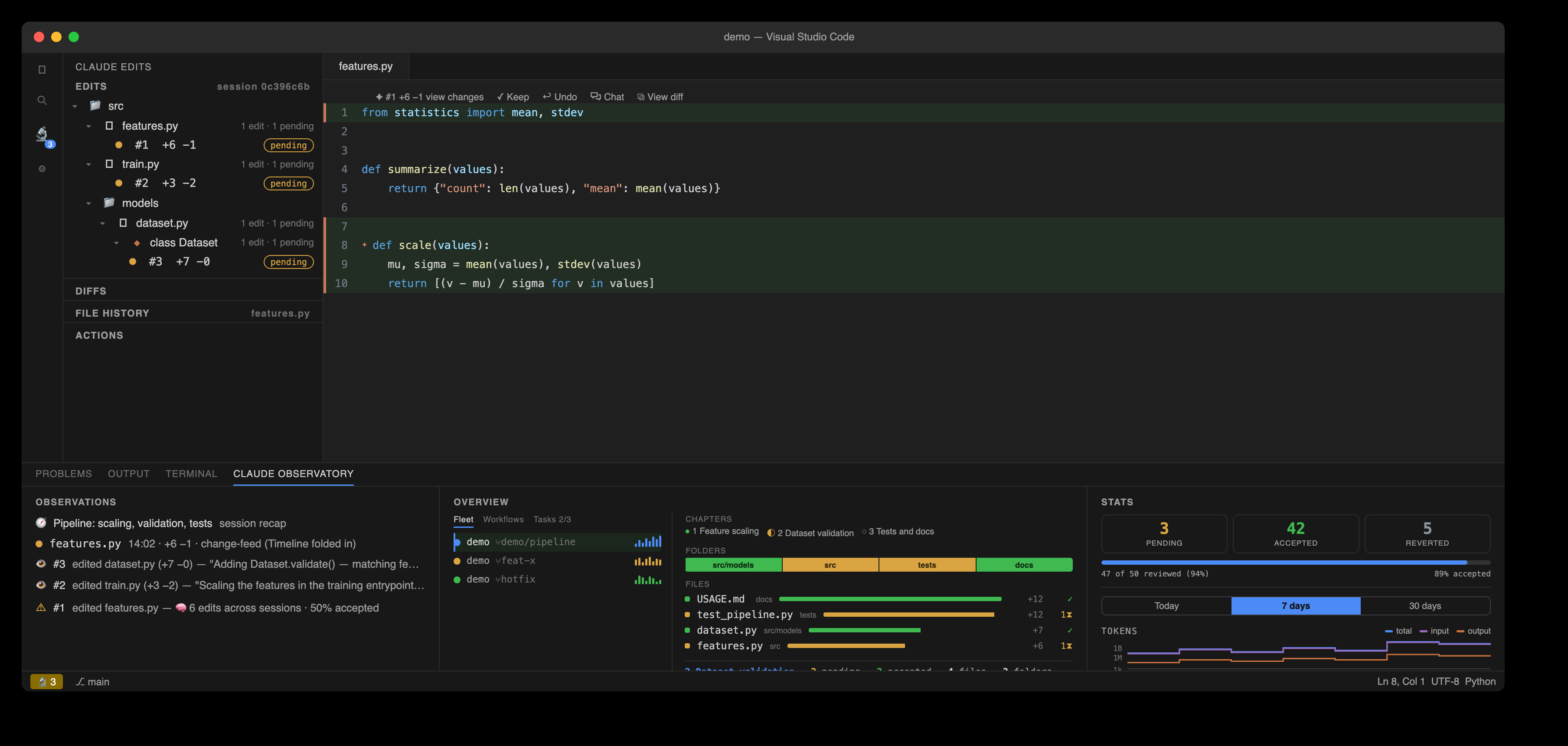
Claude Observatory in VS Code: the Claude Edits sidebar and the Claude Observatory bottom panel
VS Code
Claude Observatory in PyCharm: the same two tool windows with icon-only tabs
PyCharm / JetBrains
06
Everyday usage

Command-line usage

The claude-observatory CLI is a first-class front-end over the same store; the quick reference below covers the common commands. For more detail, see the full walkthrough, every surface in Features, and every control by name in the Panels reference.

Terminal · quick reference
claude-observatory status # hooks + hook-path health + active session + counts
claude-observatory list # edits in the active session (grouped by file, ±lines, status)
claude-observatory diff <id> # colored before/after for one edit
claude-observatory keep <id> # mark reviewed; no disk change
claude-observatory undo <id> # surgically undo one edit
claude-observatory task-keep <id> # keep every pending edit shown under a chapter (WYSIWYG)
claude-observatory task-undo <id> # revert every pending edit shown under a chapter (WYSIWYG)
claude-observatory multitask --json # every running agent across the repo's worktrees
claude-observatory tasklog # cross-agent task log: one row per stable taskId
claude-observatory chat-context # ready-to-paste chat prompt about an edit/action/subagent/task
claude-observatory demo # replay a scripted session through the real pipeline
claude-observatory demo --clean # removes the demo session, its store, and the demo folder
Next

Try it yourself